
Stories like this over the last few weeks have left me feeling confused; it’s hard to understand how peace can be decided so remotely from the people it concerns. On Sunday suicide bombings in Damascus and Homs killed 140 people. How can these both be versions of the same story? Reconciling all the different versions of reality seems almost as out of reach as reconciliation between all the people involved in perpetuating the conflict.
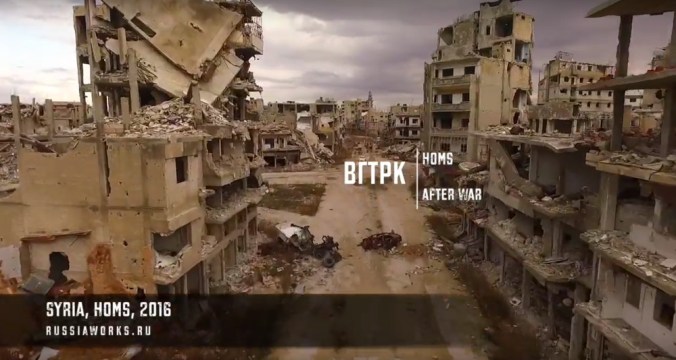
One thing that is clear is the impact that the conflict continues to have in people’s lives in the meantime. A friend who lived in Homs recently shared the shocking recent drone footage of the extent of the destruction of his city, with these words:
“Wondering for how long I will be still able to remember you my lovely home city “Homs” the way you used to be. It will always be hard to believe what I see in this video. Goodbye Homs. I truly loved everything about you.”
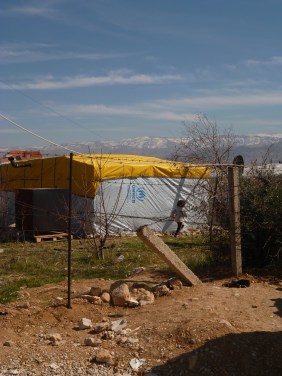 This week I sat in a tent in Lebanon’s Bekaa Valley with a family who fled their homes in Aleppo at the start of the conflict five years ago.
One of the women smiled as she told us,
“We laugh at ourselves because we used to see people living in tents on the news, refugees from Yemen or Iraq – and now we have become those people.”
I was reminded of how easily that could be me, or any one of us; and equally how easily fear, the way stories are presented to us in the media, and our distance, allow us to see them as people that could never be us.
I know that I’m unusually lucky to have had this opportunity to connect with some of the people behind the story – to drink sweet Syrian tea together and to share stories about our families, to laugh and to watch children play. But in the UK, and even in my comfortable life in Lebanon, I usually feel very far removed from the people at the heart of this story I care deeply about.
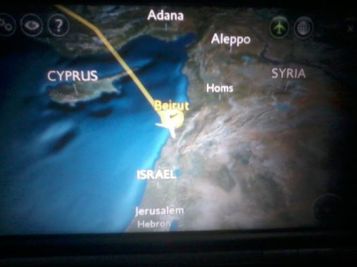 This idea of being disconnected is something I’ve been thinking about recently in terms of my ‘two lives’ in the UK and in Lebanon. I still struggle with each transition, wanting to hold onto the people and the place I am leaving behind, often thinking of what I’m missing out on being part of with the people in the place where I’m not.
So, lately I’m trying to lose the fear of missing out – a lesson I learn by deliberately choosing in each moment to be present in the lives of the people I’m with. It could mean sharing tea with Syrians in the Bekaa Valley, it might look like enjoying breakfast with my housemate in Oxford, or it might be finding a way to practically encourage someone who is deeply engaged in meeting the needs of the people who are on my heart.
I have a feeling that peace on a bigger scale also has something to do with connecting; finding ways to know the people who are actually very often living lives not so different to ours – wanting to find work, to do the best for their children, to be safe. I love my work in Lebanon because I get the chance to, in small ways, be alongside people who are deeply committed to and connected with with the Syrian families they are serving, and I love that I get the chance to share these stories with you.
 On the day I visited the family from Aleppo, I also visited a new project we have started which is providing catch-up education for children right there amongst the tents they are living in. I saw a classroom full of children eager to learn, and a Syrian teacher who (despite the difficulties of managing the behaviour of children who have been out of school for several years) shone with something that looked a lot like peace as he spoke about his sense that what he is doing is something really important; and I believe it is.
Maybe there will be peace in Syria this weekend. Maybe there won’t. But right now we can choose to be present and be connected where we are with the people around us. And we can also choose to find ways to connect with and listen to the stories of the many people who, unnoticed, beneath the surface, are quietly building peace; a peace that I suspect may have more impact that we can understand.
‘The future is not somewhere else but here and now: sunlight, rain dancing.
Stop trying to prove yourself; become a swallow in flight; blur of joy.
Change in Syria or the next Syria starts here: with me, with you.’
(From ‘Unfurling’ by Ian Adams)
 This feeling of being battered by storms reminded me of my trip to the Philippines just before I moved to Oxford. Despite the fact that the purpose of my trip there was to evaluate the response to a previous typhoon, it hadn’t even remotely crossed my mind that I could be on the island of Samar when another storm hit. Yet a couple of days into my trip we started to hear that another severe typhoon was on a path straight towards us. This meant that despite plans for a packed schedule of meetings and interviews, with a week in the city evaluating the work of a big international NGO, most of my trip was in the end spent in a remote part of the island either waiting for the (very slow moving!) typhoon, battening down the hatches, and missing the whole second week of plans through not being able to travel in the aftermath.
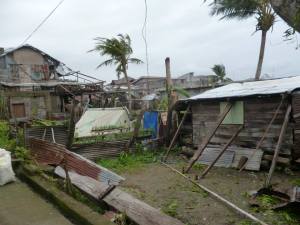 This may not sound like the makings of a great trip; I was meant to be spending my second week with an American colleague who in fact never made it onto the island at all because the typhoon was already approaching by the time she was due to arrive, making it too dangerous for her to get there. From the outside it might look like she was lucky to miss it, but in fact, in the end I actually felt that I was the lucky one because I had the chance to be there in the midst of it.
 shelter in the house I was staying in, the sense of togetherness singing songs the night before the typhoon and at daybreak as the typhoon passed, and in the days after where it wasn’t safe to travel and I spent time visiting families, and sat out under the stars listening to stories and songs, are memories I treasure as a gift I didn’t ask for, expect or deserve. A sheer gift where I was in a specific place with particular people at a moment in time that I could never have planned for but is something I will always be grateful for.
 practice the way that who we are is so much more important than what we do (as well as provided many happy hours of lego construction); rhythms of doing life together have given me structure and grounding in what have been uncertain and changing times, and have often been filled with laughter and sometimes with shared tears; it’s been freeing to be given permission to care deeply for people and know that I’m also loved; and more than ever before I have felt that I’ve had roots which are deep enough to mean that coming back from a place like Iraq or Lebanon hasn’t been hard but has genuinely been a real coming home. I’m deeply grieving the loss of these things as the community in this form has come to an end far sooner than we hoped, and when I had it so briefly, and when there seemed to be so much potential for reaching beyond ourselves into the community around us.
 these people is something that endures. I believe that we’ll still see the things we hoped for emerge in different ways in the future – but for now, it’s enough for me to choose to recognise this time as a gift and value all it’s been and all it’s given. In this storm, and the others I’ll go through, I hope I can choose to recognise the gifts in the midst of grieving for what’s been lost. Thank you fellow 244-ers for being home, and for being a gift to me by being who you are.

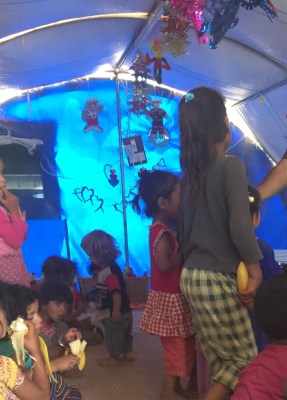 Children love having a safe and fun place to go and spend time, and the child friendly spaces act as an entry point for the team to identify children in need of further support and to work to support the whole family. This is possible here because of this organisation’s long-term focus on work around keeping children safe and their deep knowledge of the local context and systems that come from having been present in northern Iraq over many years.

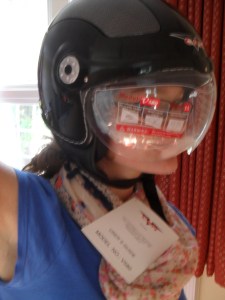 Most of the time, our impulse is to make sure that we do whatever we can to stay safe, and usually that’s not a bad idea! I’m really glad that I decided to buy a motorbike helmet before I moved to Kampala – while travelling around the city is always pretty risky, it feels good to know that my head is at least slightly protected!
![FCO 301 - Lebanon Travel Advice Ed16 [WEB]](https://keziahereandthere.org/wp-content/uploads/2015/06/150202_fco_301_-_lebanon_travel_advice_ed17__web_.jpg?w=242&h=300) The travel advice maps on the FCO website also help to feed into our desire to draw lines around what is safe and what is unsafe. It’s reassuring to think that you could stay in the green area forever and never let your feet cross over into yellow, and certainly not red, and then danger cannot touch you.
The travel advice maps on the FCO website also help to feed into our desire to draw lines around what is safe and what is unsafe. It’s reassuring to think that you could stay in the green area forever and never let your feet cross over into yellow, and certainly not red, and then danger cannot touch you. kezia here and there